


Builders Turn RWA into Programmable Money with the Two-Token System

Most stablecoins have one job: hold a dollar.
But a digital dollar just sitting in your wallet doesn't earn or finance anything. It just holds the peg. A new generation of builders is changing that, creating stablecoins backed by real-world assets that also put capital to work. Hold the base token for stability and liquidity. Stake it, and you're financing something tangible like AI hardware, institutional credit, or digital infrastructure.
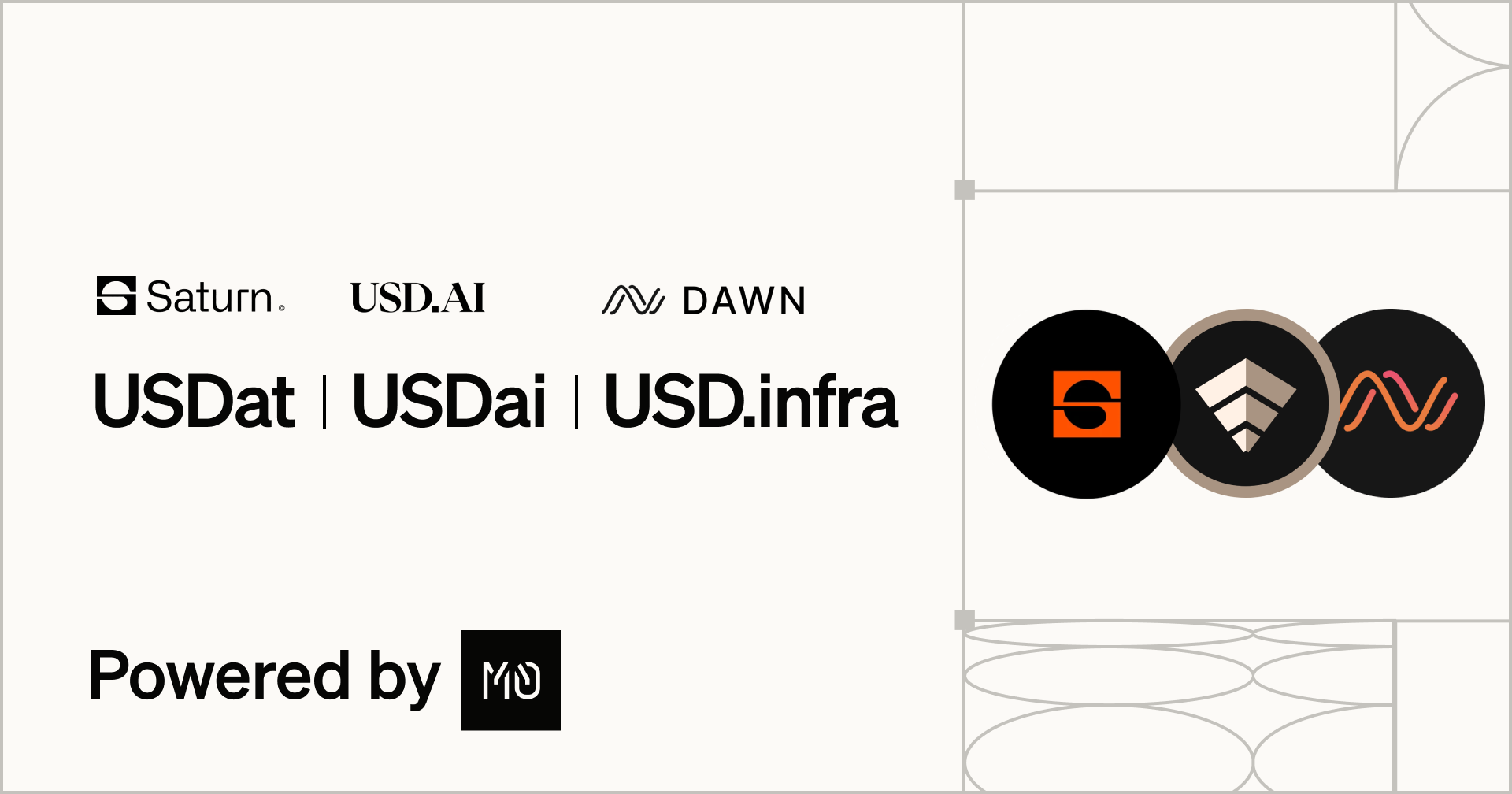
Three teams building on M0: Saturn, USD.AI, and DAWN are early examples of this model in action.
The Two-Token Model Gives Teams Twice the Capability
Most stablecoins treat collateral as a black box. The reserve exists to maintain the peg, but what it does beyond that rarely reaches the user.
What's different here is democratization of exposure. With a two-token system, the collateral becomes actively deployed into real-world activity and the staked token gives holders direct access to the returns that collateral generates. The base stablecoin stays simple, liquid, and redeemable, and the staked version becomes where the collateral exposure lives.
Saturn: Institutional Credit, Accessible to Anyone
Saturn is building a structured finance layer on top of digital credit like STRC.
Saturn's base stablecoin, USDat, is 100% backed by Treasury bills. Stake it for sUSDat, and you get exposure to Strategy’s preferred equity (STRC), with Bitcoin as the underlying collateral, currently targeting returns of 11.5%+.
STRC and digital credit are credit-like instruments backed by Bitcoin. Saturn's goal is to make these assets accessible and composable. If you can connect a wallet, you can access digital credit and use it across DeFi protocols. Two segregated layers, clearly separated: USDat for stability, sUSDat for collateral-driven returns with transparent risk. Saturn’s USDat is backed by PYUSDx, a developer platform designed to let builders create their own onchain products, fully backed by PYUSD.
USD.AI: Financing the Hardware Behind AI
Financing the GPU clusters and compute infrastructure powering the AI boom is the world’s biggest challenge (and opportunity). The market is the largest, fastest growing in the entire world by CapEx and it has been almost entirely invisible to DeFi, until now. USD.AI is a protocol that finances AI infrastructure at institutional scale through non-recourse, GPU-secured loans, giving capital providers liquid, on-chain exposure to income-producing basket of high-performance compute debt.
USDai is a synthetic dollar backed by PYUSD, soon via PYUSDx. Stake it for sUSDai, and you get exposure to loans collateralized by real GPU hardware and AI infrastructure. Borrowers are operators financing compute capacity. sUSDai holders get exposure to the returns that collateral generates.
The base token is liquid and redeemable across DeFi. The staked token is exposure to something that didn't exist on-chain before.
DAWN: Stake Into Real-World Digital Infrastructure
DAWN is building a digital infrastructure network that enables users to participate in funding AI compute and connectivity deployments that serve real customers and generate revenue.
Through DAWN, capital funds the deployment of physical connectivity and compute infrastructure. DAWN issues USD.infra, a stablecoin used to finance infrastructure rollout within its network.
The model is straightforward: Users mint USD.infra, providing the capital used to deploy infrastructure. Holding sUSD.infra represents a stake in structured, revenue-backed onchain instruments, subject to applicable transfer and eligibility restrictions. This revenue then flows back through the DAWN ecosystem through a defined distribution order.
Minting USD.infra means participating in funding the deployment of real, physical infrastructure that is shaping the modern Internet.
A Strong Foundation, Built for Many Directions
Saturn, USDai, and DAWN operate in different markets and serve different users. What they share is a deliberate architectural choice to use infrastructure that allows their teams to build onchain products the way their business works, not the other way around.
Most stablecoin deployments bundle the things builders actually need to control: reserve management, token logic, monetization model, liquidity mix, and reward distrbution. Change one element and you're renegotiating with the platform. M0 separates those layers for builders to customize and configure, so the stablecoin reflects their product requirements rather than their stablecoin provider's defaults.
For Saturn, that means structuring a two-token system with clearly separated risk layers. For USDai, it means building a synthetic dollar composable across DeFi while routing rewards to a staked token backed by real hardware loans. For DAWN, it means a stablecoin that backs an entire network and a staked token that benefits from its success.
In every case, M0 handles compliance controls, redemption mechanics, and composability across chains while builders bring the domain expertise and the product vision. What these three companies are constructing is a dynamic stablecoin system designed for the asset class, the collateral, and the users they actually serve. That level of precision requires infrastructure designed for builders who treat money as a competitive advantage instead of an off-the-shelf utility.
Saturn is available to eligible participants outside the United States and EEA. Yield is variable and not guaranteed. Not an offer or solicitation where prohibited and not offered from the EU.
Saturn terms and disclosures: https://saturn.credit/legal/terms-conditions