


PayPal and M0 launch developer platform for PYUSD, already crossing $100M+ in scale

TL;DR
- Decentralized exchanges cleared close to $13 trillion in trading volume in 2025 across spot and derivatives. Most of that activity is quoted, margined, and settled in stablecoins.
- Stablecoins have reached scale ($303 billion in circulation, $7.2 trillion in monthly transfer volume), but maturity requires tooling for developers to build custom products on top of established assets.
- For tokenized currency to achieve durable adoption, leading stablecoins need to become platforms that trusted monetary bases’ developers can extend with their own rails, without rebuilding the trust, reserves, and liquidity underneath.
- PayPal understood the immense value developers could bring to PayPal USD (PYUSD). Building on top of an existing stablecoin relies on enhanced onchain architecture. That is one of the primary opportunities that M0 was built to address. PayPal came to M0 to build the PYUSDx platform.
- PayPal, M0, and MoonPay have launched PYUSDx, a developer platform that lets businesses launch their own onchain products, fully backed by PYUSD. M0 built the platform's infrastructure; MoonPay holds the PYUSD reserves backing it.
- As of Sept. 9, 2026, three companies are live: Saturn, Concrete, and Cap, with over $100 million in processed volume on the PYUSDx platform. Two more (USD.AI and Fairblock) will go live soon.
- Builders inherit PYUSD's trust layer and liquidity while getting access to developer tools across onchain rewards, access controls, branding, reserve configuration, cross-chain behavior, and ecosystem connectivity. Every token built on PYUSDx can be swapped for PYUSD and USDC through native onchain liquidity.
Stablecoins weren’t built for developers
Stablecoin circulation crossed $300 billion for the first time last October and has held above it since, sitting at roughly $303 billion today. In February 2026, monthly transfer volume reached $7.2 trillion, overtaking the US ACH network for the first time. A main driver of that usage is DeFi. Decentralized exchanges processed $4.9 trillion in spot trades in 2025, onchain derivatives added another $7.9 trillion, and most of that activity is quoted, margined, and settled in stablecoins. By the measures that matter to many in the financial industry, stablecoins have arrived. But we believe there’s much more potential for onchain money.
Digital money will be used in every aspect of the financial system, just as bank deposits are used today as a primitive for more complex financial use cases. But that expansion looks unlikely unless onchain money can act as an open network of tools and solutions that help new and existing businesses build products and services. That’s something that most stablecoins onchain today don't quite offer. Stablecoins, like USDC and USDT, use a narrow design; they’re issued and controlled by one company, with one set of rules, for every user and every use case. Those design constraints are limiting, and don’t allow them to act as programmable money used by developers to build the next wave of innovative brands and products.
PYUSDx: the onchain development platform backed by PayPal USD
PayPal saw that the durable value of PayPal USD (PYUSD; one of the most widely used stablecoins since its launch in 2023) would come from what others could build on it, and they wanted to give developers flexible tooling to build powerful products. They envisioned an extensible platform that sits on top of PYUSD and uses its compliance, trust, and liquidity as a foundation for new product offerings, while strengthening their supply and building out an ecosystem around PYUSD. PayPal came to M0 to build the onchain architecture to structure minting, reserves, rewards, and controls so that others can build against them safely on top of PYUSD.
Introduced by PayPal, M0, and MoonPay, PYUSDx is a developer platform that lets businesses and individual developers launch their own onchain financial products on top of PayPal USD (PYUSD). Three projects are live at launch: Saturn, Concrete, and Cap, with over $100 million in processed volume on the platform. Each has different users, different business models, and different requirements for how their tokenized dollar should behave. That they can each build a distinct product without rebuilding the underlying layer is what PYUSDx was designed to make possible. It is the first platform of its kind that M0 has built with a partner. It will not be the last.

The stablecoin market is maturing fast. What separates the next phase from the last isn't the asset. It's what companies can do with it. PYUSDx is designed to answer that.

PYUSDx architecture
PYUSDx is built on PYUSD, a Paxos-issued stablecoin fully backed by U.S. dollar deposits and Treasuries. Builders inherit PYUSD’s trust, liquidity, and compliance, alongside development tools and a faster, more cost-efficient path to market.
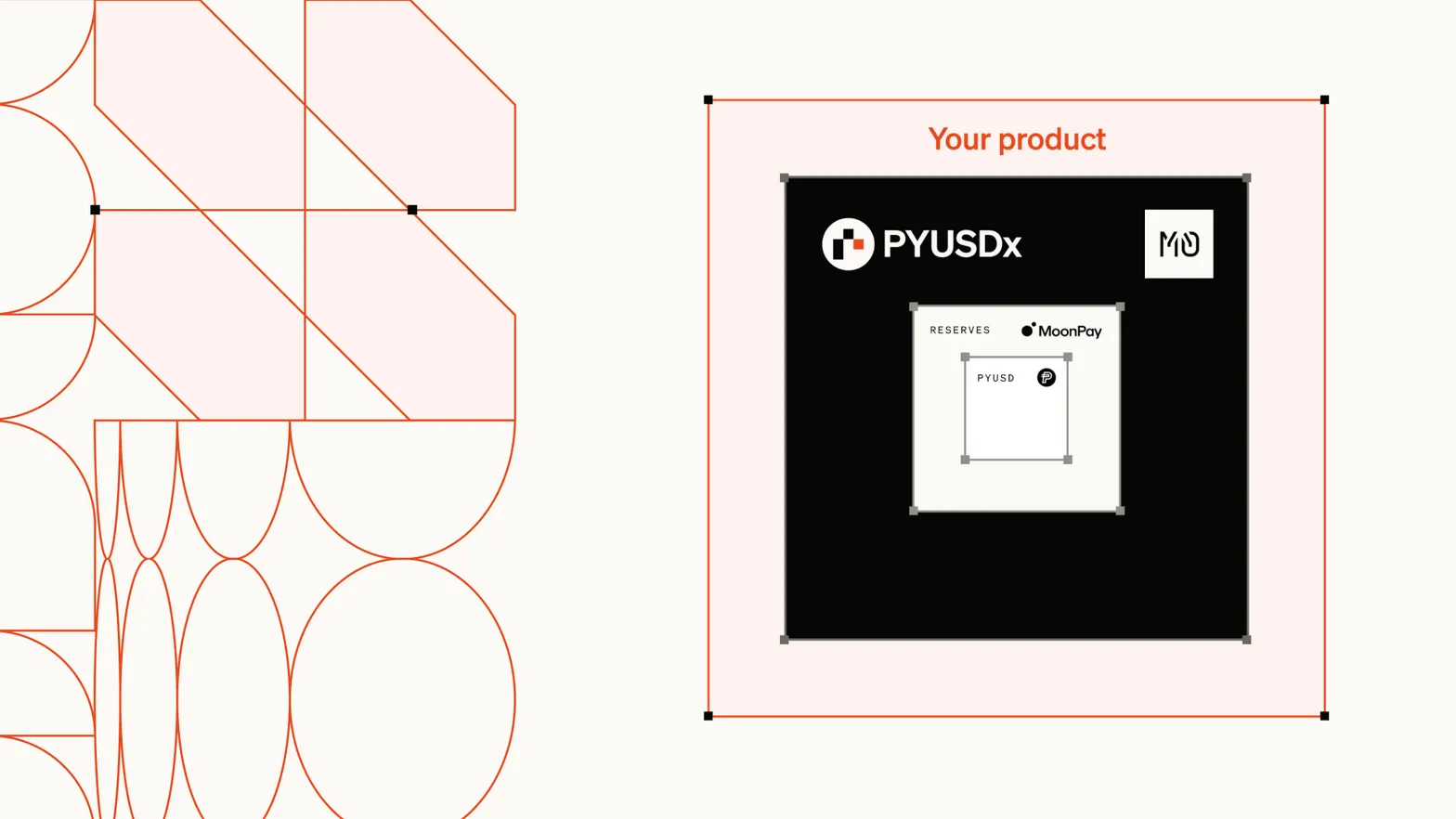
M0 built the developer platform that powers PYUSDx with modular infrastructure that gives builders contract-level control over how their onchain products behave. The layers most stablecoin platforms bundle into a fixed stack are each individually configurable here. To start, that means those building on PYUSDx control:
- Branding: Custom token name, symbol, and branding.
- Reward distribution: Per-account or pooled reward routing to whoever they designate.
- Access controls: Account-level freeze, pause, and compliance primitives.
- Multi-asset collateral: Support for multiple reserve asset types.
- Cross-chain portability: Native bridging across EVM-compatible chains.
PYUSDx also offers swapping to PYUSD and USDC through native onchain liquidity, so a builder’s product is never stranded in its own silo.
MoonPay, through MoonPay Digital Assets Limited, holds the PYUSD reserves backing PYUSDx and provides collateral transparency to builders and their users. PayPal is the first global consumer payments brand to make its stablecoin extensible, giving PYUSD new functionality and letting builders leverage it directly, with official PayPal integrations opening up as circulation grows.
We were honored to have PayPal select M0 as their official partner to build developer capabilities into the PYUSD ecosystem. They’re the first global consumer payments brand to transform its stablecoin into a developer platform, and it was the perfect opportunity for the tech we’ve built at M0.

The launch partners
Three companies launched on PYUSDx on September 9, with two more currently building and set to follow later this year. Each one took the same infrastructure and built something distinct with it.
Every stablecoin platform makes choices about which layers to bundle together and which to leave open. We built PYUSDx so the product layer belongs to the builder. The three companies launching on it today are each making a different product, and that's the entire point.

Saturn
Saturn is a structured finance protocol built on digital credit. USDat, issued on PYUSDx, is Saturn's digital dollar for everyday liquidity and settlement. Its staked counterpart, sUSDat, gives holders exposure to STRC, a Strategy instrument that currently pays a variable distribution.
By structuring products on digital credit, Saturn turns STRC from an isolated equity position into a full asset class with distinct risk and return profiles.
Concrete
Concrete powers onchain vault infrastructure, using automated systems to allocate, rebalance, and compound returns across DeFi venues such as Morpho. PYUSDx provides the stablecoin infrastructure underlying concUSD, which is designed as a dollar-denominated asset for the Concrete ecosystem. Users seeking rewards can separately deposit concUSD into Concrete vaults, including sconcUSD, to access underlying yield strategies.
Cap
Cap is a credit platform that's powered by financial guarantees. With backing from Franklin Templeton, Cap has pioneered a three-sided market where depositors are able to accrue principal protected rewards through supplying loans to borrowers that underwriters backstop with their own capital. Cap is launching cUSD on PYUSDx as the native currency for its credit platform.
USD.AI
USD.AI provides AI infrastructure operators with strategic, non-dilutive financing facilities essential for their scale requirements. The protocol delivers non-recourse loans secured exclusively by the underlying GPU infrastructure, isolating risk from the corporate balance sheet. USD.AI's financing is asset-backed, transparent, and settled onchain using USDai, providing capital providers with direct exposure to income-producing compute assets through sUSDai. USDai is live today, with its stablecoin migrating to PYUSDx.
Fairblock
Fairblock is building a confidentiality layer for all stablecoins, payments, and institutional flows. Rather than a separate privacy chain or wallet, it plugs into stablecoins and tokenized assets on the chains they already live on. It enables encrypted onchain activity while maintaining full institutional compliance and fast performance. To begin with Fairblock is building the flagship Confidential USD (CUSD) on PYUSDx, the first confidential stablecoin with both confidential and public transfers.
Build on PYUSDx
PYUSDx is live today. If your business needs a dollar that behaves the way your product does, the base layer is no longer the part you have to build. Learn more about the platform and what you can build on it at m0.org/PYUSDx.